
4t is just the beginning
What if the journey from reporting in Power BI to budgeting, forecasting and planning could be measured in hours, not months? With KOKAI’s 4t, the aim is simple: if you already have a semantic model in Power BI, you should be able to get started with Aimplan in a single morning. But for us, those four hours are really just the start of something bigger.
Before the summer, we soft-launched what we now call 4t. The concept is built around a simple idea: if you have already invested in Power BI and have a semantic model containing your general ledger, accounts and departments, you shouldn’t necessarily need a lengthy implementation project to get started with planning.
We build on what is already there. In four hours, we connect Aimplan to your existing model and set up reporting, budgeting and forecasting. This means you can move from using Power BI primarily to understand what has happened, to using the same data foundation to plan what happens next.
But 4t isn’t simply about getting everything set up in four hours. It’s about getting to the point where you can start creating value, learning and developing the solution further.
A starter package that’s actually meant to be the start
When you get started with 4t, you get more than the implementation itself. Your Aimplan licence and KOKAI Care are included for the first 12 months, and through KOKAI Care, you’ll also get two QA sessions with our consultants.
That’s a deliberate choice.
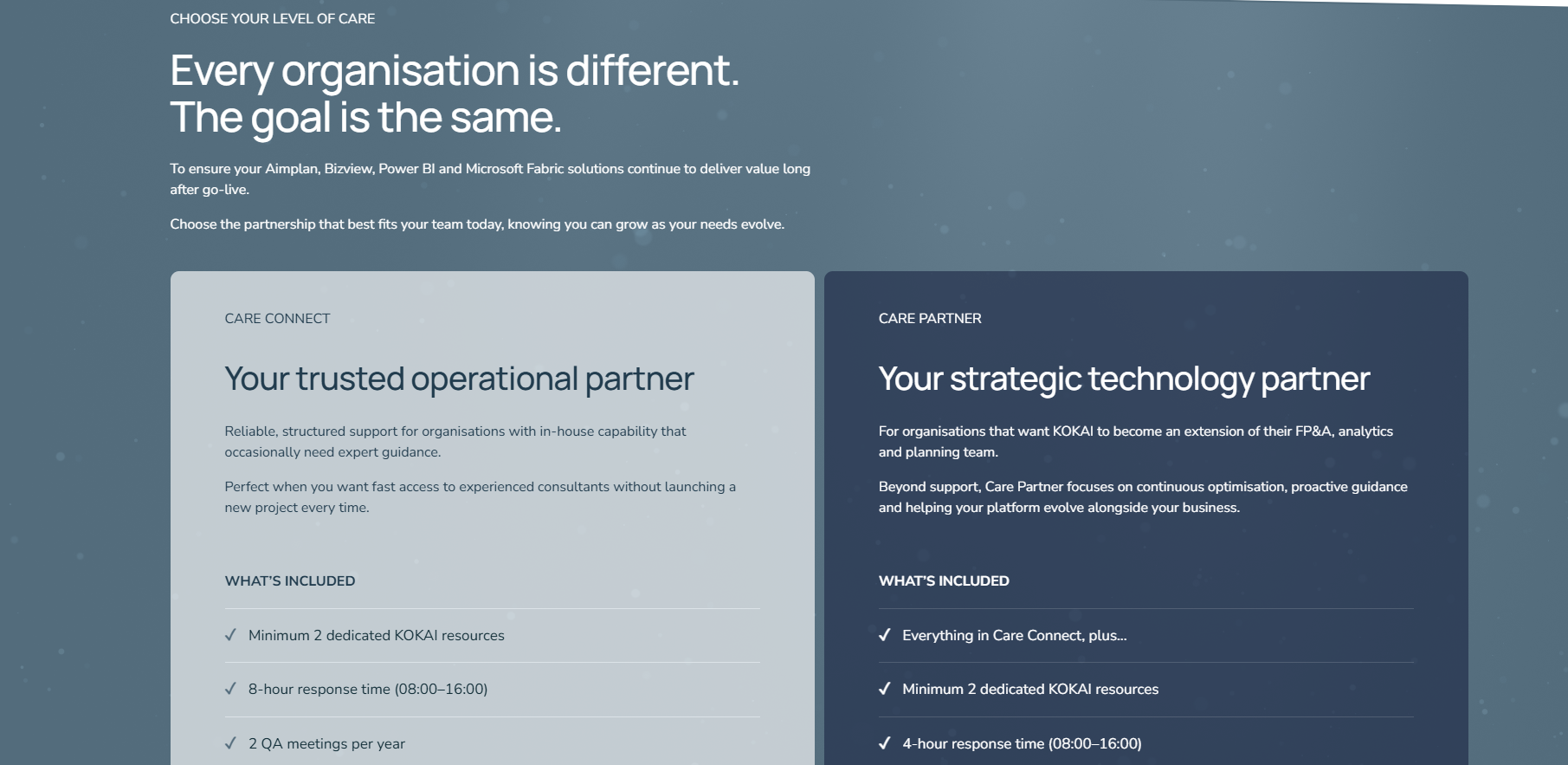
KOKAI Care
We don’t want to deliver a solution, hand it over and wait for you to get in touch when something goes wrong. We want to understand how the solution is being used, what new needs emerge and where there are opportunities to make your processes even better.
We don’t want to deliver a solution, hand it over and wait for you to get in touch when something goes wrong. We want to understand how the solution is being used, what new needs emerge and where there are opportunities to make your processes even better.
The two QA sessions give us a natural opportunity to look beyond the technology. How are your budgeting and forecasting processes working once Aimplan is in place? Which manual processes are still there? Have new needs emerged? Are there areas where you could make smarter use of the data foundation you already have?
This is where 4t starts to become part of something bigger.
KOKAI is not here to be a traditional consultancy
We provide consulting services, but our ambition isn’t to build a company where value is measured primarily by the number of billable hours. We want to develop solutions, concepts and services that make it easier for our customers to get more value from the data, technology and processes they already have.
4t is one example. KOKAI Care is another.
t
The same mindset runs through our people. In our LinkedIn series, Meet the Minds Behind the Models, we’ve spoken to several of our consultants about what motivates them in their work at KOKAI. One recurring theme is the satisfaction that comes from understanding a customer’s challenges and existing processes, then finding a better, simpler or smarter way to solve them.
Sometimes, that also means challenging the process that’s already in place.
For us, that’s an important part of being an adviser. Technology is a tool. The real value comes from understanding how to use it to improve the way a business actually works.
What comes after budgeting and forecasting?
Let’s say you’ve started with 4t. Reporting is in place, your budget is in Aimplan, your forecast is connected to the same data foundation, and your organisation is starting to get used to a new way of working.
That’s when the next question becomes interesting: What else can we use this for?
Project planning is a good example.
Aimplan’s project model shows just how much is possible when planning, actuals and reporting work together throughout the entire project lifecycle. The process starts with creating and defining the project, then moves through project budgeting, resource capacity, time and cost registration, rolling project forecasts, project follow-up, revenue recognition and, ultimately, the project P&L.
What makes this interesting isn’t simply the number of features. It’s how the information connects.
From project budget to a living forecast
Before the project begins, you can establish an initial project budget covering expected revenue, costs, hours, staffing, timeline and profitability. This becomes the project baseline and feeds into both the rolling forecast and the overall project view.
Once the project moves into execution, reality starts to meet the plan. Hours are recorded by employee, project and activity. Costs are captured as they occur. At the same time, resource capacity can be tracked across employees, weeks, projects and activities.
This creates the foundation for something far more useful than a static comparison between budget and actuals.
It creates the foundation for a living project forecast.
In the rolling project forecast, previous periods are locked to actuals based on recorded hours and costs, while open periods initially draw their values from the original project budget. These can then be adjusted based on what you know today. Updated expectations for hours and costs flow through to the overall project view.
The question therefore shifts from “How are we performing against budget?” to the perhaps more important “Where do we actually expect the project to land?”
Spot the problems before they grow
When information is brought together in this way, project follow-up takes on a different role. Aimplan’s project overview compares planned and forecast values, using variance calculations, among other measures, to highlight potential overruns.
The purpose of the model is to track execution against the plan and continuously understand progress, delays and remaining work, so that issues can be identified before they develop into larger project overruns.
At the same time, the flow of information doesn’t stop at project status. The model connects project activity to the financials. Earned revenue can be tracked and recognised, with the recognised values flowing through to the P&L. Ultimately, the business can analyse performance both at an overall level and for each individual project.
Project planning, resource utilisation, actuals, forecasts and financial performance therefore don’t need to exist as separate processes with separate versions of the truth.
They can all be part of the same model.
This is where KOKAI Care comes in
We don’t expect everyone who starts with 4t to need project planning as well. That would be the opposite of how we want to work.
But perhaps you do.
Perhaps six months down the line, you find that your budgeting and forecasting processes are working well, while project follow-up is still spread across several Excel files. Perhaps resource planning turns out to be the real challenge. Perhaps you need better rolling forecasts. Or perhaps, together, we identify an entirely different area where Aimplan and your existing data foundation could make a difference.
These are exactly the kinds of conversations we want to have in our KOKAI Care QA sessions.
Not just: Is the solution working?
But also: What can we do better now?
Start with four hours. Build from there.
As an Aimplan Elite Partner, of course we want to be experts in the technology. But that isn’t enough. We also need to understand the processes the technology is there to improve, and the challenges the people using it actually face in their day-to-day work.
That’s why we develop concepts like 4t. It’s why we’ve built KOKAI Care around continuous follow-up. And it’s why we’re constantly exploring new ways to use Aimplan, Power BI and the data our customers already have.
You don’t necessarily need to know what the final solution should look like before you begin.
Start with 4t.
Get started with Aimplan, budgeting and forecasting in a single morning. Use the solution. Learn what works. Use KOKAI Care and the QA sessions to identify what could be better.
Then we build from there.
Because four hours can be enough to get started. It’s what happens next that gets really interesting.
